Fall 2024
Oct 11
3:00-4:30
In-person/Online
Nebraska East Union (Great Plains)
Dr. Julian Alston
Research-Driven Productivity Growth Redux: Are Ideas Really Getting Harder to Find?
Abstract - Recent studies using semi-endogenous growth models claim that the slowdown in U.S. productivity growth reflects a widespread and systematic decline in productivity of researchers—in other words, ideas are getting harder to find. In this article we challenge the underlying conceptual model, the corresponding measure of research productivity, and the apparent implication that declining productivity of researchers is clearly responsible for the observed slowdown in productivity growth. We present a range of evidence including measures for the national economy, agriculture, and wheat breeding, all of which negates the notion that research productivity is fading fast.
PDF (Not available)
October 4
FYH 210, 3:00 PM
Dr. Murray Fulton
Topic: Property Rights and Agricultural Policy Since 1800: A Political Economy Analysis.Abstract -
In 1798, Malthus argued that the world was stuck in a cycle of poverty, where any increase in food supply would give rise to increases in population which would quickly exhaust the food supply. Two hundred and twenty-five years later, the Malthusian problem has been addressed in a significant way through substantial increases in the effective land growing area and by very large increases in yield made possible by improved genetics and large increases in the use of equipment, chemicals, fertilizers, and water. This presentation argues that solving the Malthusian problem was not pre-ordained, but instead came about through a series of policy changes driven by myriad political factors. The policy changes had their impact through property rights and the accompanying system that supports these rights. This presentation traces these changes to property rights and explores their implications for addressing contemporary problems such as climate change.
Spring 2024
March 8
3:00-4:30
In-person/Online Only
Dr. Karina Schoengold
Topic: Integrating Economics with other Factors in Managing Water Resources: Successes and LimitationsAbstract - Natural resource managers and legislators have been inconsistent with incorporating incentives and economic recommendations in natural resource policy design. While this is a consistent theme across many natural resources, one area where it is especially relevant is water management. Water transcends boundaries in complex ways, creating challenges for appropriate regulation. Water quantity regulations, which vary by state in the western United States,
will be a focus of the talk. Economic guidelines, physical realities, and legal constraints for both groundwater and surface water systems will be discussed. Recommendations on policy designs that reconcile biophysical and political realities with relevant incentives will be highlighted.
Fall 2023
November 17
3:00-4:30
In-person/Online Only
Dr. Alexis H. Villacis
Topic: Feeling the Heat: High Temperatures and Farm-level Agricultural ProductivityAbstract - Extreme temperatures affect agronomic attributes and plant growth, thus affecting agricultural productivity. We investigate the impact of extreme heat on total factor productivity (TFP) at the farm level in Nigeria using household surveys from the World Bank and satellite weather data. Our findings show that a rise in high temperatures during the growing season decreases TFP. Particularly, we show that an increase in the share of growing season hours with temperatures above 35°C decreases TFP at the farm level. Further results show that high temperatures decrease yields but not the value of agricultural production at the farm level as in response to a rise in extreme temperature, farmers increase their farming acreage. We discuss various implications regarding policy approaches focused on input use intensification as a coping strategy to face rising temperatures.
Spring 2023
April 26
3:00-4:30
In-person/Online Only
Dr. Johan Swinnen - CANCELLED
Topic: Global Food Security in CCC (Conflict, Climate, Covid) TimesAbstract - The world is not on track to eliminate hunger, and many populations face the triple burden of malnutrition: undernutrition, micronutrient deficiencies, and overweight and obesity. At the same time, food systems are putting pressure on our planetary boundaries. Food and nutrition security vulnerabilities and environmental challenges have been exacerbated by the three C’s: Conflict, Climate, Covid-19. In his presentation, Dr. Johan Swinnen will draw attention to the populations disproportionately affected by the effects of climate change, the global pandemic, and the food and fertilizer crisis worsened by Russia’s invasion of Ukraine. While high prices are particularly challenging now, price shocks may be the new normal. Dr. Swinnen will therefore explore ways to enhance resilience and inclusive policy responses, highlighting the latest evidence from IFPRI's research.
April 7
3:00-4:30
In-person/Online Only
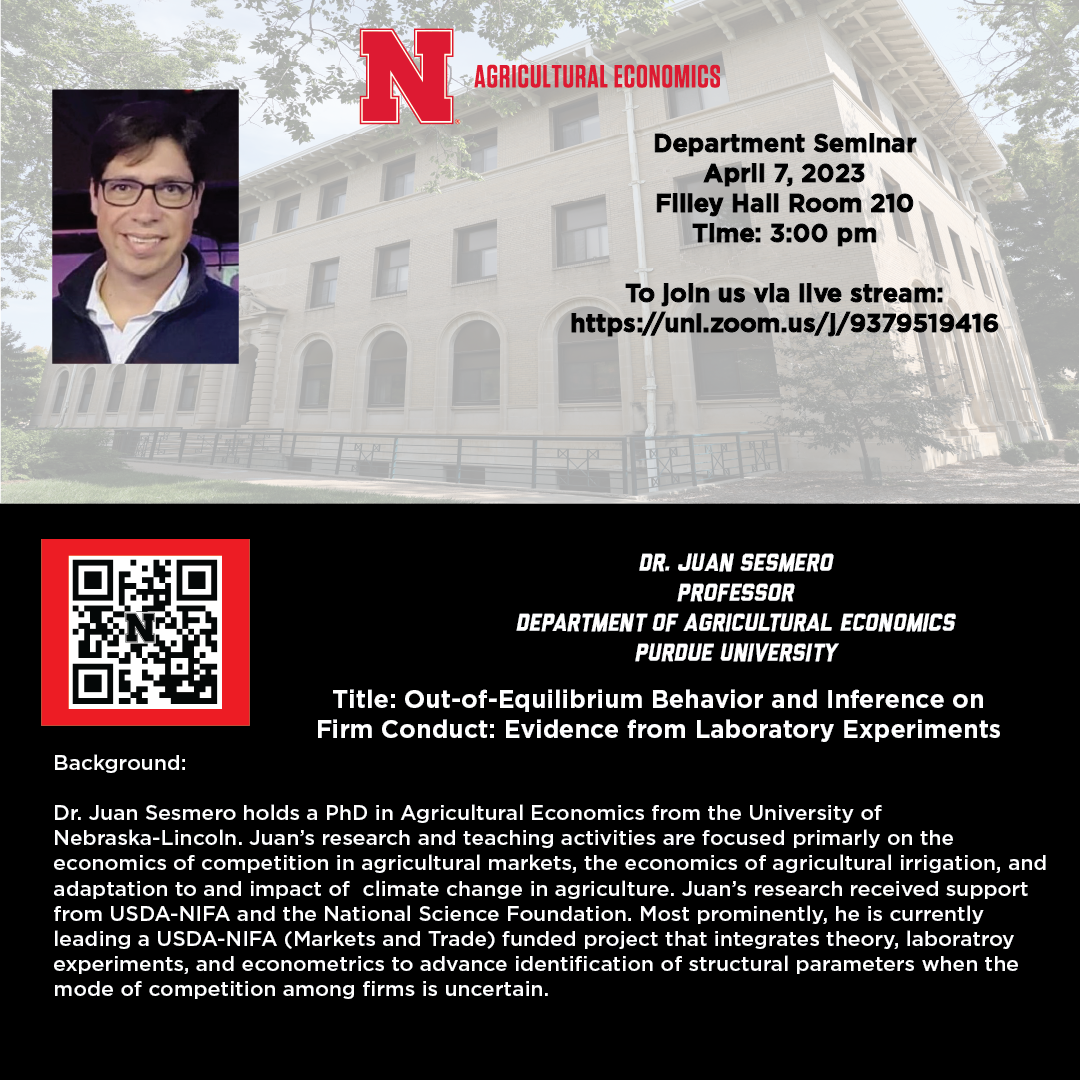
Dr. Juan Sesmero
Topic: Out-of-Equilibrium Behavior and Inference on Firm Conduct: Evidence from Laboratory ExperimentsBackground - Dr. Juan Sesmero holds a PhD in Agricultural Economics from the University of Nebraska-Lincoln. Juan’s research and teaching activities are focused primarly on the economics of competition in agricultural markets, the economics of agricultural irrigation, and adaptation to and impact of climate change in agriculture. Juan’s research received support from USDA-NIFA and the National Science Foundation. Most prominently, he is currently leading a USDA-NIFA (Markets and Trade) funded project that integrates theory, laboratroy experiments, and econometrics to advance identification of structural parameters when the mode of competition among firms is uncertain.
Fall 2022
Nov 18
3:00-4:30
In-person/Online Only
Dr. Ed Rubin
Topic: Power Plants, Air Pollution and Regulatory ReboundBackground - Interactions between overlapping regulations can have unintended impacts on polluting activities. We document one such potentially important interaction. Local regulators in areas constrained by one type of air quality regulation—threshold-based local air quality standards—are incentivized to permit more local pollution in response to a decline in emissions induced by another kind of regulation—rules targeting power plant emissions. We combine a state-of-the-art particle trajectory model, machine learning, and an econometric model of local air pollution exposure to quantify the relationship between sustained reductions in upwind power-plant emissions of pollution (PM2.5) precursors and downwind pollution levels. We use this integrated air quality modeling framework to test whether pollution levels in constrained counties appear to "rebound" when emissions from upwind pollution sources decline. We document evidence that is consistent with a local emissions rebound.
Oct 10
3:00-4:15
In-person/Online Only
Dr. Amy Ando
Background Info:Abstract - Ando is a Professor at the University of Illinois Urbana-Champaign in the Department of Agricultural and Consumer Economics. She earned a B.A. in economics from Williams College in 1990 and a Ph.D. in economics from M.I.T in 1996. Prior to joining the faculty at Illinois she worked as a Fellow at Resources for the Future for three years where she is currently a University Fellow. Ando has secured grants from sources including the National Science Foundation, the U.S. Environmental Protection Agency, and the U.S. Department of Agriculture - NIFA. Papers emerging from her research have appeared in Science, the Proceedings of the National Academy of Sciences, the Journal of Environmental Economics and Management, Land Economics, Resource and Energy Economics, the Journal of Law and Economics, Conservation Biology, and numerous other scholarly journals and books. Ando is currently one of the lead Co-Editors of the American Journal of Agricultural Economics and has served as a handling editor for other highly ranked journals. She has worked on review panels for multidisciplinary grant competitions at the National Science Foundation and participated in expert advisory workshops related to stormwater and wildlife habitat policy for the EPA and the USDA (respectively). Ando has served on the Advisory Committee for the Environment Program at the Doris Duke Charitable Foundation on advisory groups to help the City of Chicago form and evaluate stormwater initiatives, and currently on the Science Advisory Board for The Nature Conservancy in Illinois. She is currently an elected member of the Board of Directors of the Agricultural and Applied Economics Association, and previously served as a Board member and then Vice President of the Association of Environmental and Resource Economists.
October 3
3:00-4:30
Online Only
Dr. Samarendu Mohanty
Topic: The Role of Potato in Building Sustainable Agri-Food Systems in Asia
Oct 5
3:00-4:30
In-person/Online Only
Krishna Paudel
Background info:Krishna’s work focuses on water quality and water quantity, technology adoption, and international development economics. Krishna has served the agricultural economics and other affiliated professions in several roles, such as Editor of the Journal of Agricultural and Applied Economics, and as President of the Southern Agricultural Economics Association. He currently serves as Associate Editor for two journals: Natural Resource Modeling and Journal of Water Resource Planning and Management.
September 30
3:00-4:30
In-person/Online Only
Dr. Murray Fulton
A Behavioral Model of Political EconomyAbstract - There is a strong sense currently that western democracies are unable to address their most urgent and critical challenges. Whether it is climate change, income inequality, water shortages, or lack of urban housing, governments appear to be incapable of taking the bold policy steps needed to address these major issues. The main roadblock to change appears to be political. While solutions exist to most of the problems, policy makers are unable to pursue them because of the political backlash that will be unleashed.
The argument developed in this presentation is that these policy breakdowns occur because the proposed policy solutions fundamentally alter society's underlying institutions or rules of the game, which in turn alter the existing power relationships and the distribution of income, both of which are valued. Policies are the result of decisions made by the elite — i.e., those people in society with political power. In this framework, policy formation is understood to rest on an institutional foundation, one that has been built up over time by previous elites for their own substantive purposes. This institutional foundation plays a key role in structuring the elite's decision-making. In addition. the elites are assumed to have a preference for the status quo due to loss aversion. Taken together, these two decision-making determinants — one macro and institutional and one micro and cognitive-based — combine to create a behavioural approach to political economy. This approach integrates the work of authors from numerous disciplines, including behavioural economics, cognitive psychology, political science, institutional theory, and transaction cost economics.
Spring 2022
June 21
3:00-4:30
In-person/Online Only
Dr. Simone Valle de Souza
A Comparative Choice Experiment with Leafy Green ConsumersAbstract - As technology evolves at a fast pace, consumers remain somewhat bound to traditional concepts of agricultural systems, showing adverse reactions to ag-tech developments. On the other hand, these very consumers state their appreciation for some of the most important improvements offered by ag-tech, such as easy access to year-round and consistent supply of higher-quality product. Information exchange between producers and consumers becomes key to ascertain the speed and direction of innovative technology development that meets consumer expectations and understanding. The emerging Indoor Agriculture (IA) industry is an example in which technology evolves rapidly, and billions of dollars are being invested in large-scale leafy green production systems. Some of the main attributes of this industry are associated with year-round production, consistent quality and supply, potentially pesticide-free and locally produced fresh produce, revitalization of local communities and lower carbon footprint. However, this industry struggles to grow, despite significant crop production research development, mostly because producers face the risk of large capital investments coupled with the uncertainty associated with consumer perceptions and acceptance of IA technology. Through a discreet choice experiment and latent class analysis three distinct groups of consumers with diverging preferences and willingness to pay for attributes were identified. Results show that although heterogeneity was significantly higher for production methods (i.e. IA, greenhouse and field farming) than product attributes, 55% of consumers accept the technology and are willing to pay a premium for attributes that IA offers. Penultimately, these results help producers to create marketing strategies that appropriately target consumers supportive of the enhanced production or product attributes achieved by urban-located indoor leafy food production systems, and the development of this industry which carries strong environmental and social advantages.
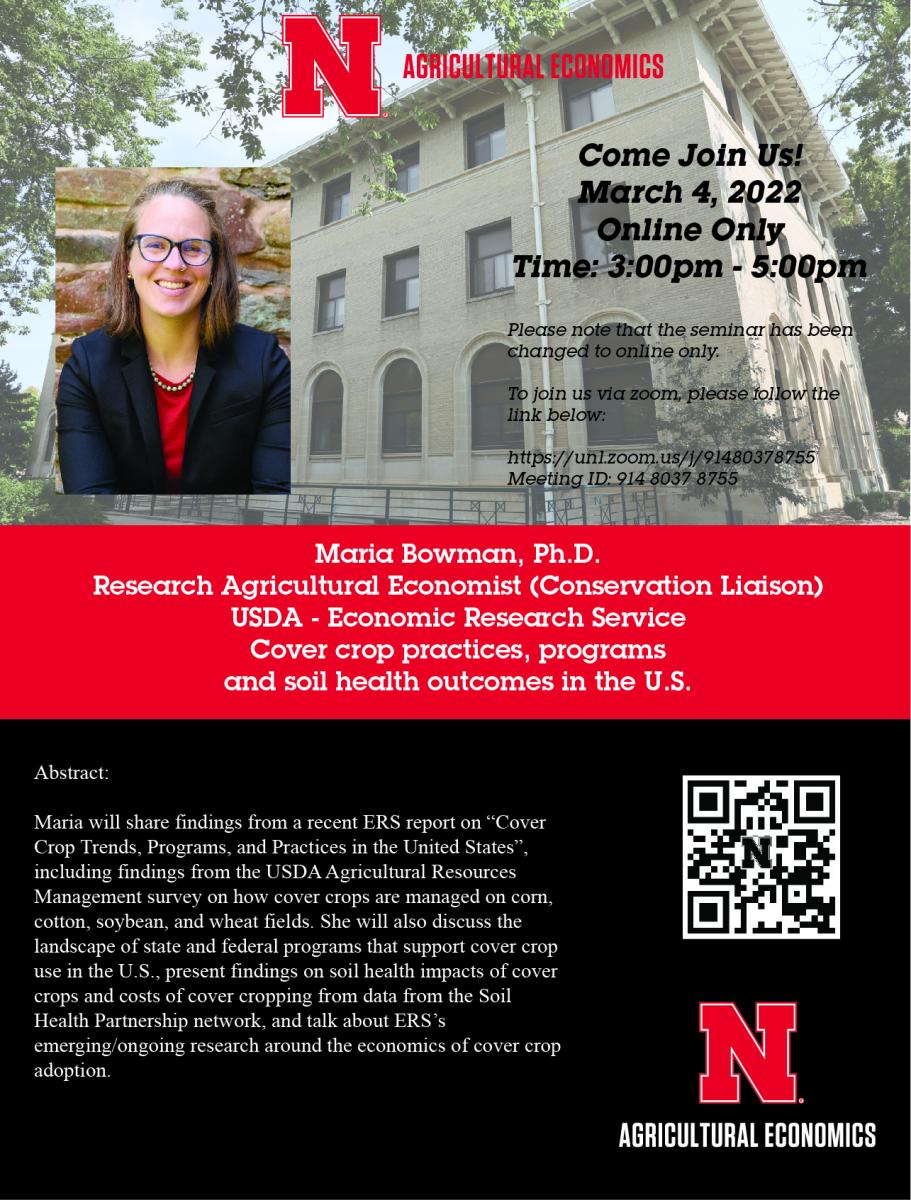
March 4
3:00-4:30
Online Only
Maria Bowman
ERS, USDA
Cover crop practices, programs and soil health outcomes in the U.S.
April 8
3:00-4:30
Filley Hall 210
Andrew Plantinga
U.C. Santa Barbara
Title - Environmental Markets: Is the Promise of Coase Fulfilled?
Abstract -
It has long been recognized that common-pool resources, if left unmanaged, tend to be inefficiently over-extracted. This “problem of the commons" remains pervasive today as many natural resources around the world deplete at unprecedented rates. In 1960, Ronald Coase proposed that the assignment of property rights to resources can counter over-extraction and improve welfare by providing incentives for more efficient resource use. These appealing predictions have led to the recommendation of property rights for nearly every common-pool resource - from fisheries, forests, water, to the global climate - and provide an intellectual foundation for the use of environmental markets more broadly. The effectiveness of property rights, however, is predicated on a number of stylized theoretical assumptions, many of which are violated in practice. Thus, it is an empirical question whether property rights will be effective under real-world conditions. In this talk, I will review the empirical literature on the performance of environmental markets, including discussion of my recent paper on groundwater markets (Ayres, A.B., Meng, K.C., and A.J. Plantinga. 2021. Do Environmental Markets Improve on Open Access? Evidence from California Groundwater Rights. Journal of Political Economy 129(10):2817-2860).
April 29
3:00-4:30
Filley Hall 210
Richard Sexton
U.C. Davis, Filley-Geary Lecture
Title - Modern Food Supply Chains and Meeting the Challenges of Feeding Ourselves Through the 21st Century