
Content
March 18, 2026
2026 Nebraska Farmland Values and Cash Rental Rates
Figure 1. Historic Nebraska Average Land Value, Selected Years 1978-2026a
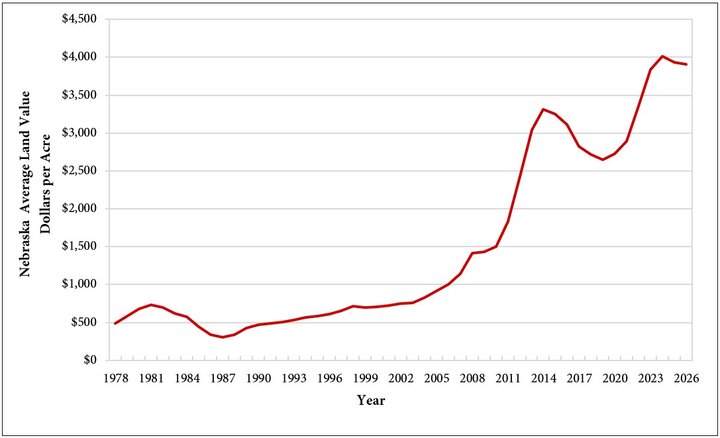
Source: a UNL Nebraska Farm Real Estate Market Surveys, 1978-2026.
Figure 2. Nebraska Agricultural Statistics Districts

Land industry professionals responding to the annual survey attributed the decline in Nebraska agricultural real estate values to current crop prices, farm input costs, and prevailing interest rates. Lower commodity prices across the state have tightened the financial position of many agricultural operations. Current farm input costs and interest rates place elevated financial pressure on operating expenses and influence decisions about agricultural land investments. Prevailing interest rates have kept borrowing costs elevated for lines of credit used to lease land and for long-term loans for real estate acquisitions.
Lower crop receipts in Nebraska led to a net decrease of approximately $576.65 million, or 16%, in crop receipts in 2025. The decline in crop receipts across the state was also driven by declines in corn prices and lower production of soybeans and wheat. These losses were partially offset by a $3.22 billion increase in livestock receipts statewide (Lubben, 2025). Profitability differences between crops and livestock affected the market value of land classes serving each industry. Margins are tight for Nebraska crop producers in 2026 due to ongoing crop prices and input costs.
Current farm input costs have tightened liquidity positions and margins for crop producers. Heightened expenses follow strong farm loan demand and reduced liquidity positions (Kreitman & Cooray, 2026).
These financial conditions have led to a gradual deterioration in credit positions for certain operations (Scott & Kreitman, 2026). Survey respondents indicated that the financial positions of operations influenced the trends between cropland and grazing land.
Average interest rates on all types of farm loans remain above the 10-year average even as rates have declined from 2023 peaks (Scott & Kreitman, 2026). Lenders across the Tenth District of the Federal Reserve Bank of Kansas City reported that current interest rate levels increased financing costs for highly leveraged operations. The finances of crop and livestock operators influence their lending needs and overall position (Kreitman & Cooray, 2026).
The estimated market value of dryland cropland without irrigation potential decreased by 1% statewide compared to the previous year (Table 1). Northwest, North, Central, and Southeast Districts declined by 3% to 5%. The average change across the other four districts varied from -1% to 2%. Dryland cropland with irrigation potential declined 2% for the state. Districts in the Northwest, Northeast, Southwest, and Southeast experienced declines of 3% to 6%, while other regions showed changes ranging from -2% to 2%. Low crop prices decrease the incentive to develop irrigation on land.
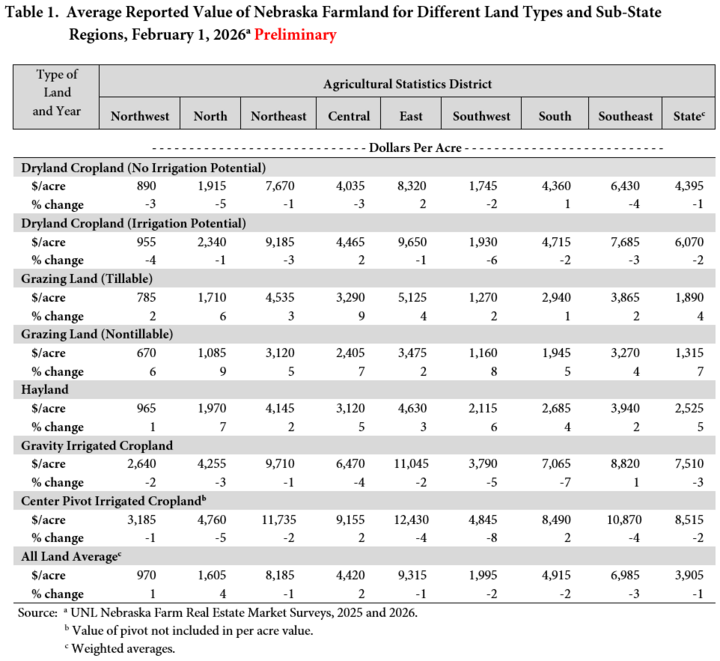
Center pivot irrigated cropland averaged 2% lower in 2026, with declines in the North, East, Southwest, and Southeast ranging from 4% to 8%. The Northwest and Northeast fell by 1% to 2%, while the Central and South increased by 2%. Declining land values extended to gravity irrigated cropland in 2026, with an average decline of 3%. Reported changes in market value ranged from a 7% decline in the South to a 1% increase in the Southeast. Declines in the market value of irrigated land classes reflect tighter crop margins in 2026.
The values for grazing land and hayland rose between 4% and 7%. Nontillable grazing land led the three land classes with a 7% increase as rising cattle prices increased market competition for additional acres. Northwest, North, Central, and Southwest Districts reported gains between 6% and 9%. Tillable grazing land increased by 4%, and hayland rose by 5%. Higher cattle prices were capitalized into grazing and hayland markets to support livestock enterprises.
Cash rental rates for dryland and irrigated cropland decreased throughout Nebraska in 2026 (see Table 2). Survey participants reported that pressure on commodity prices contributed to cropland cash rental rates trending lower. Favorable 2025 U.S. rainfall in key grain regions has held prices low for the upcoming growing season. Input prices for seed, fertilizer, and chemicals remain high relative to expectations for crop prices. Incorporating flexible lease provisions can help reduce production risk and price uncertainty when establishing a new lease agreement for the coming year.
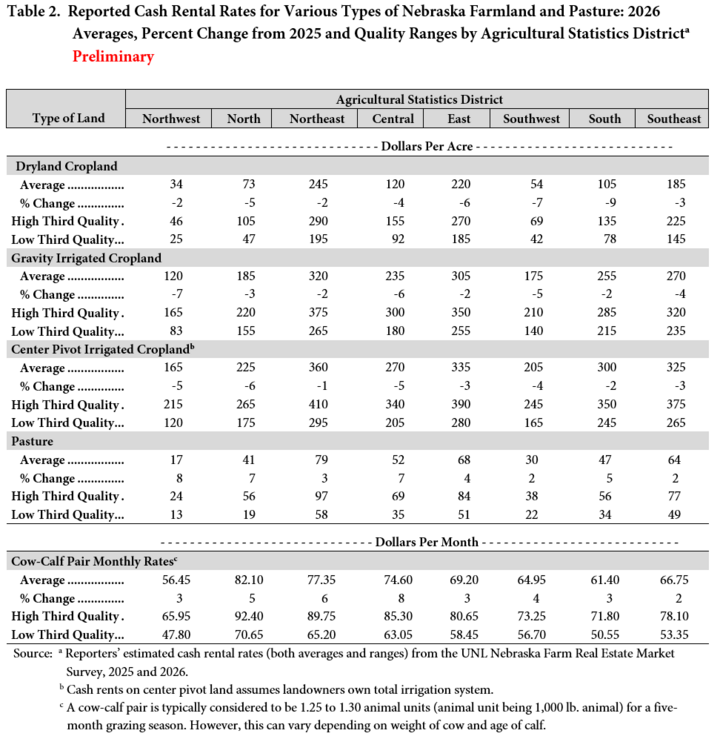
Dryland and irrigated cropland reported cash rental rates declined between 1% and 9% compared to the previous growing season. Cash rental rates for irrigated cropland assume the landlord owns the entire irrigation system. If the tenant supplies any irrigation system component, the rental rate should be reduced to account for that contribution. Actual crop revenue, production expenses, and drought considerations may be important factors to consider when structuring a flexible lease in 2026.
Rental rates for pasture and cow-calf pairs trended higher across Nebraska in 2026 (Table 2). The rates increased by about 4% to 5% compared to the prior grazing season. Cash rental rates for grazing land reflect strong cattle prices and ongoing shifts in national livestock inventories. Rental negotiations should include early removal clauses to address potential drought conditions during the upcoming grazing season.
The level of service provided by the landlord or tenant influences the rental rates for cow-calf pairs included in the lease. Considerations for the leases include the party responsible for maintaining fences, controlling noxious weeds or brush, and paying utility bills for livestock wells. As shown in Table 2, the high third quality for cash rent may reflect some of these negotiated lease provisions.
Land values and rental rates presented in this report are averages of survey participants’ responses by district. Actual land values and rental rates may vary depending on the parcel's quality and the local market. Also, preliminary land values and rental rates are subject to change with the return of additional surveys. Final results from the survey will be published in June 2026 and available online via the Nebraska Farm Real Estate website: http://cap.unl.edu/realestate/
Please address questions regarding preliminary estimates from the 2026 Nebraska Farm Real Estate Survey to Jim Jansen at (402) 261-7572 or jjansen4@unl.edu.
References
Kreitman, T., & Cooray, A. (2026, February 11). Farmland Values Remain Firm Despite Deterioration in Farm Finances, retrieved March 9, 2026, from the Kansas City FED.
Lubben, B. (2025, October 1). Fall 2025 Nebraska Farm Income Outlook, retrieved March 9, 2026, from the Rural & Farm Finance Policy Analysis Center.
Scott, F., & Kreitman, T. (2026, March 6). Farmland Values Remained Strong in 2025, retrieved March 10, 2026, from the Kansas City FED.
Generous support from donors to the Mary S. Montague Center for Agricultural Profitability Excellence Fund (NU Foundation Fund #01173890) made this publication possible. To learn more or contribute, visit: https://nufoundation.org/fund/01173890/.
Jim Jansen, (402) 261-7572
Agricultural Economist
Department of Agricultural Economics
University of Nebraska-Lincoln
jjansen4@unl.edu