
Content
April 22, 2026
Most recently, while researching information about the cost of irrigating with electricity, using NPPD’s (Nebraska Public Power District’s) four options for purchasing electricity, it occurred to me that with the introduction of electrical storage (batteries), it might be possible to use several of these various rate differences to reduce costs while maintaining full access to power. NPPD’s four purchase programs/options are No Control (NC), Time-of-Use (TOU), and two interruptible programs, Two-Day/week-Control (TDC), and Anytime Control (ATC). The challenge of using TOU is the escalating kilowatt costs during peak hours (10 am to 10 pm), twelve hours a day, and still be able to fully irrigate the crop during its high-water consumption phase, see Figure 1. For TDC and ATC, their issue relates to possible power shutdowns (usually in five-hour blocks) on various weekdays at a critical phase of production, possibly reducing yields. These shutdowns and price spikes, as shown in Figures 1 and 2, become more problematic during mid-season due to the increase in irrigation needs caused by hotter weather and increasing crop maturity. These three programs are incentivized by offering cheaper rates. Further information about the individual programs is available at: https://www.nppd.com/accounts-billing/your-rates/irrigation-rates, https://agecon.unl.edu/four-nebraska-public-power-district-nppd-irrigation-electricity-purchase-options/, and https://cap.unl.edu/powering-pivot-webinar-2026/.
Figure 1. Comparison of corn plant water needs and the number of control days by NPPD for the years 2009 to 2024
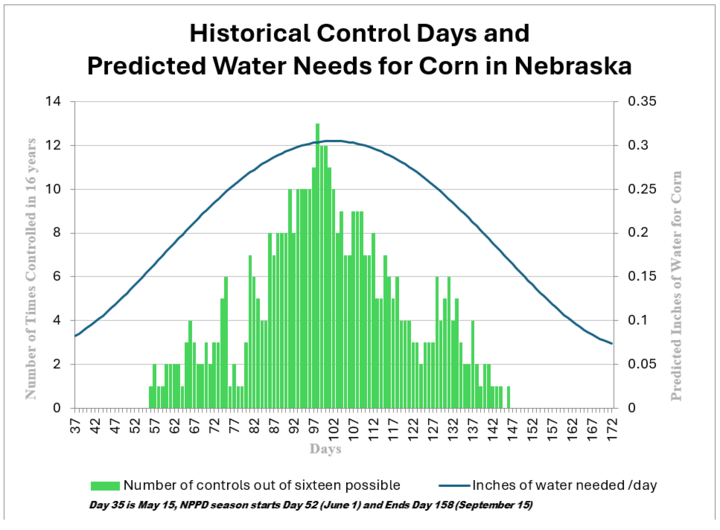
If irrigation is needed during these periods when the power is shut off or is very costly, the power could be supplied from stored electricity in batteries. The question is, would that be an economically wise choice? Answering this question requires establishing the amount of electricity needed for the shortfall and the cost of storing it. This, unfortunately, is a difficult task to accomplish and requires detailed information about the individual irrigation system capacity, the particular circumstances, including year, rainfall, etc. Instead of pursuing the answer in specifics, a more general approach is used. The NPPD data, reflected below in Figure 2, captures the number of times the utility announced a control event (ACE) for the 2009 to 2024 seasons, which was 482 times. These ACE’s became control events (CE’s) 260 times, about 54% of the time. The average annual number of CE’s for the period is 16.25. The number of ACE’s, CE’s, and annual averages are also listed in Table 1.
Figure 2. The number of NPPD control days announced ACE’s by day of the irrigation cycle and the corresponding historical percentage of time the ACE became a control event CE.

Using additional equipment information collected from various sources on the web, a simplified budget of what it would approximately cost to build a battery system to power a 40-kW (kW = kilowatt) system. The budget has a low and a high estimate to cover its likely range of costs. It is expected that some may find the low-cost estimate to be too high and others to find the high estimate to be too low. Regardless, the point of the budget is to begin the process of discovering the likely economics of using batteries to offset announced shutdowns and peak pricing schemes. How close is the current cost of the technology, battery storage, to being practically and competitively used? The analysis is simple and straightforward and does not include factors such as subsidies, tax advantages, or grants, which, of course, may change the outcome. From Table 1, it is likely that batteries are nowhere near the economic threshold, adding an estimated minimum of $0.60/kWh (kilowatt hour) and a high of $1.11/kWh for five hours of power 16.25 times a year for the next twenty years. The twelve-hour battery option, used to pump during peak hours, the TOU option, has a lower cost per kWh, with a low of $0.43/kWh and a high cost of $0.82/kWh. These costs are in addition to the cost per $0.0618/kWh.
Table 1. Simplified cost estimate to install backup batteries for electric shutdown (ATC and TDC contracts) and TOU higher peak kWh prices

These costs are conservative based on the fact that the average 16.25 irrigation events would be for the full five or twelve hours and would always be necessary. This is not likely the case, since some are likely to occur when irrigation may not be needed, or through careful management can be worked around. It should be noted, however, that varying circumstances can alter the economics drastically. For instance, consider the TOU option where seasonal irrigation totals 1008 hours. This is a 40-kW system. In this scenario, half of the hours rely on the battery during peak and near-peak times, twelve hours a day, for a total of 504 hours. Battery cost is priced at $91/kWh, reducing the system costs to $62,680, with the same 20-year life. The average kWh cost for this system is estimated to be $0.1055/kWh, slightly less than the NC $0.1088/kWh charge. This is at the current $0.0618/kWh cost of power.
The remaining question is: Given the current discounts, how much money is available to purchase technology to fill the void when power is either expensive or shut down? Using NPPD’s current rates and expected kWh used in a season, we can calculate the cost savings of the various purchase options. Using the lowest rate of each purchase option, Table 2 lists the amount of savings available due to the kWh rate differences from the NC option. Looking at the 40-kWh column of the table, the largest savings, or the amount available on an annual basis to have the same usage as NC, is $1,880. This implies that if battery power costs more than $1880 annually, it is more expensive than just buying the power with the NC option, with the level of usage assumed here. Currently, buying power from NPPD is much cheaper than buying battery storage, but this will likely change with time. Who knows, there may be programs in the future that will help mitigate costs, or perhaps electrical storage may become a factor in balancing grid power and may become a more valued by the power supplier, both of which would make battery purchase a more viable option.
Table 2. Realizable savings of the various purchase options at their lowest rates

Matt Stockton, Professor
Department of Agricultural Economics
West Central Research and Extension Center
University of Nebraska-Lincoln
matt.stockton@unl.edu