
Content
April 1, 2026
The Effectiveness of Wellhead Protection Areas on Groundwater Quality: Evidence from Nebraska
Nutrient legacies pose a persistent threat to environmental quality and human health by prolonging exposure to pollution long after its original source has been reduced or eliminated. This issue is particularly important in the context of groundwater, where contaminants from nonpoint sources, especially agricultural nitrate leaching, can remain and travel below the surface for many years.
While the delayed response of groundwater systems is well understood in the natural sciences, it has received far less attention in policy discussions. This disconnect matters. When improvements in groundwater quality do not appear immediately after interventions are implemented, policies may be perceived as ineffective, potentially weakening long-term support. Recognizing how nutrient legacies operate in groundwater systems is therefore essential for designing and sustaining effective policy.
Taro Mieno, Shunkei Kakimoto, and I contribute to this understanding by evaluating whether Wellhead Protection Areas (WPAs) are effective in reducing nitrate contamination in groundwater. Using several decades of groundwater monitoring data from Nebraska, we focus specifically on how these policies influence nitrate leaching into aquifers and how long it takes for significant improvements to occur.
Groundwater is a primary source of drinking water in Nebraska and plays a central role in agricultural production. At the same time, it is vulnerable to nitrate contamination from fertilizer and manure application among others. Nitrate move downward through the soil profile and eventually reach aquifers, where it can persist and accumulate. WPAs are designed to interrupt this pathway. These are defined areas around public drinking water wells where land use and management practices are guided to reduce the risk of contamination reaching the subsurface. Adoption of WPAs is determined locally, which leads to variation in when and where they are implemented.
Empirical Strategy and Data
To evaluate the effectiveness of WPAs in reducing nitrate leaching into groundwater, we use a dataset covering the period from 1996 to 2019. The data include more than two million nitrate observations from approximately 33,000 wells across Nebraska, providing broad spatial and temporal coverage of groundwater quality.
A key challenge is that WPAs were not implemented at the same time across locations. Instead, communities adopted them gradually. This staggered adoption complicates evaluation because standard methods typically assume a single treatment period. To address this, we apply a Staggered Difference-in-Difference model. This approach builds on the difference in differences framework commonly used in economics but allows for variation in the timing of policy adoption. It enables us to estimate the causal effect of WPAs by comparing changes in nitrate concentrations across treated and untreated areas over time, while controlling for location specific factors and common trends.
Findings
Our results (see Figure 1) show that WPAs are associated with reductions in nitrate concentrations in groundwater. On average, nitrate levels decline by about 0.6 milligrams per liter per year after a WPA is established. This indicates that policies targeting nitrate leaching near wellheads can lead to meaningful improvements in groundwater quality. These improvements, however, do not occur immediately. The effects build gradually, with the full impact becoming visible only after about 15 years. This pattern reflects the time required for nitrates already present in the soil and subsurface to move through the system and for reduced leaching to translate into lower concentrations in aquifers.
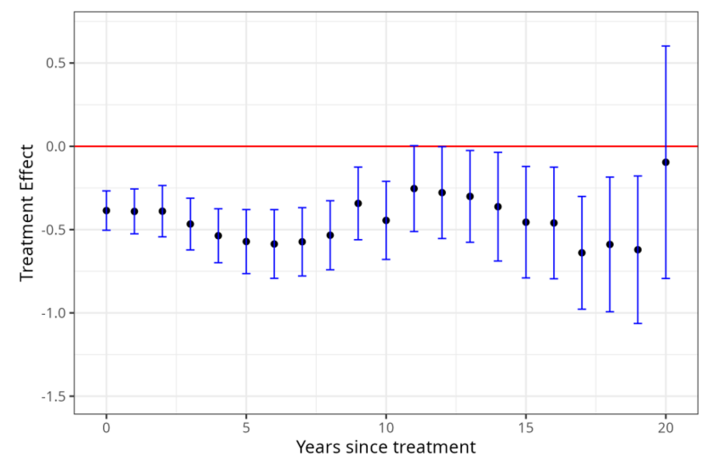
Figure 1: Event study of WPA impacts on groundwater nitrate concentrations over time since implementation
A key concern in staggered difference in differences analysis is the choice of an appropriate control group. Standard approaches often rely on all untreated areas, but this may be problematic in our setting. WPAs are typically located in populated areas such as townships and villages, while untreated areas may be more heavily agricultural and not directly comparable. To address this, we restrict the control group to observations within 2, 5, and 10-kilometer buffers around each WPA, improving spatial comparability and strengthening the validity of the counterfactual. We also estimate alternative specifications that include weather variables and agricultural land use controls to account for factors influencing nitrate leaching. The results remain consistent across these models, indicating that the observed reductions in groundwater nitrate concentrations are robust.
Nutrient Legacies in Groundwater
These findings highlight the importance of aligning policy expectations with the physical realities of groundwater systems. Reducing nitrate leaching requires targeted interventions such as WPAs, along with sustained commitment over time. For policy audiences, this has important implications. If expectations are based on immediate results, effective policies may be judged too early and incorrectly viewed as unsuccessful. WPAs can reduce nitrate leaching, but the benefits take time to appear in groundwater measurements.
The delayed response we observe reflects nutrient legacies in groundwater systems. Even after policies reduce nitrate inputs at the surface, previously accumulated nitrogen continues to leach downward, sustaining elevated concentrations over time.
By quantifying both the magnitude and timing of these changes, our study provides clear evidence of how nutrient legacies influence groundwater quality. This helps connect scientific understanding with policy expectations.
Acknowledgement - This work in part was supported by the U.S. Department of Agriculture (USDA), Office of the Chief Economist (OCE).
Disclaimer - The findings and conclusions in this blog are those of the author(s) and should not be construed to represent any official USDA or U.S. Government determination or policy.
Deshamithra Jayasekera
Post-Doc Research Associate
Water for Food Institute
University of Nebraska-Lincoln
djayasekera@unl.edu
Taro Mieno
Associate Professor
Department of Agricultural Economics
University of Nebraska-Lincoln
tmieno2@unl.edu
Shunkei Kakimoto
PhD student
Department of Applied Economics
University of Minnesota
kakim002@umn.edu