
Content
June 3, 2026
In the aftermath of the 1929 stock market crash, the U.S. government raised average tariffs to about 60% under the Smoot-Hawley Tariff Act. These tariff increases triggered retaliation by other countries with the result that global trade fell by about two-thirds (Quibria 2026). In 1947, representatives from twenty-three countries, conscious of this history, ratified the General Agreement on Tariffs and Trade (GATT) hoping to establish an international trade regime that would prevent trade wars similar to those of the 1930s. The GATT oversaw international trade until 1995 when it was incorporated into a new entity, the World Trade Organization (WTO). The WTO organizes trade negotiations aimed at reducing trade barriers and manages proceedings to resolve trade disputes (Quibria 2026).
Until fairly recently, the trade negotiations and dispute-settlement proceedings have been highly effective at establishing a rules-based international trade regime. Average tariff rates fell from around 40% in the 1940s to less than 5% by the early 2000s (Quibria). Since 1995, about 650 trade disputes have been processed (WTO 2026). More recently, however, criticism of the WTO has grown and policies adopted by the United States, China, and other countries have undermined the organization’s ability to oversee global trade. Current membership now stands at 166 and many of the issues before the WTO are considerably more complex than the simple tariff reductions that characterized the organization’s early years. The Uruguay Round of trade negotiations that created the WTO in 1995 was the last negotiating round to be completed successfully and the dispute-settlement mechanism has been rendered inoperable by the blocking of the appointment of new judges to the Appellate Body by the United States.1 The actions of recent US administrations have been particularly damaging (Kozul-Wright 2026).
The WTO operates on the basis of a few principles, the most significant of which are consensus voting (all members have to agree on the rules and actions to be taken) and Most Favored Nation (MFN). The Doha Development Round of trade negotiations launched in 2001 stalled without resolution because the members could not reach consensus. MFN is an anti-discrimination principle that requires members to extend their lowest tariffs to all the other WTO members. In recent years, conflicting interests of the diverse membership have made it almost impossible to achieve the consensus necessary for decisions to be made. As a result, countries have increasingly sought to craft bilateral, regional, or preferential trade agreements that are allowed under the WTO rules but that violate the MFN principle. The US-Mexico-Canada Agreement (USMCA), for example, allows the three member countries to set tariffs lower than their MFN rates on goods traded among them. The WTO (2026a) estimates that 80% of global trade in 2022 was conducted under non-discriminatory MFN rules falling to 72% in February 2026 largely as a result of increased US tariffs in 2025.
The 2018 US trade war gave rise to Chinese retaliation targeting US agricultural goods, notably soybeans. US soybean sales to China fell from over $12 billion in 2017 to about $3 billion in 2018 recovering to $14 billion in 2020 (FAS 2026). The Biden Administration kept most of the tariffs applied by its predecessor and the second Trump Administration has increased tariffs further. Soybean sales to China again fell to about $3 billion in 2025 as the Chinese government responded to the US actions. Most of the cost of the 2025 tariffs falls on US consumers and the tariffs have contributed to increased US inflation (Bove 2026).
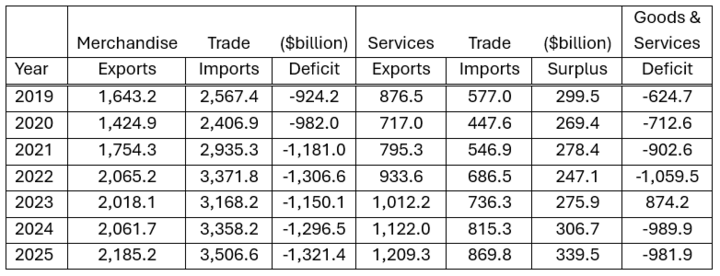
The Trump Administration argues that tariffs redress merchandise trade deficits and encourage foreign investment in the US as foreign firms seek to avoid the tariffs on their exports. Tariffs do affect the prices of goods in both the importing and exporting countries but trade deficits are caused by domestic savings and investment behavior rather than price changes (Balistreri 2025, York and Durante 2026). Table 1 shows that the 2025 tariffs had little discernable impact on the 2025 merchandise trade deficit which rose slightly. The overall trade deficit in goods and services fell somewhat but this was due entirely to a larger surplus in services trade which is not subject to tariffs. Discriminatory tariffs change the origin of imports from countries subject to high barriers to those facing lower rates. Tariff-induced declines in Chinese imports in 2025 were offset by increased imports from Thailand and Vietnam (The Economist).
Table 1: US Balance of Trade in Goods and Services (billions of current US dollars)
Source: WTO (2026a)
Trade barriers on imported Japanese automobiles in the 1980s did eventually lead to Japanese manufacturing investments in the United States but the process was slow. In addition, significant increases in foreign investment in the United States result in increased demand for US dollars and appreciation of the currency. A strong dollar raises the trade deficit by making imports cheaper (so we buy more) while increasing the prices of US exports paid by foreign importers (so they buy less).
The 2025 US tariffs have not provoked extensive retaliation and global trade flows remained strong in 2025 (WTO 2026a). Instead of erecting trade barriers of their own in response to the US actions, many countries negotiated new trade agreements among themselves. As the United States is not a party to these agreements, it will not benefit from the more favorable tariffs levied among countries that are. According to The Economist (2026), fifteen trade agreements have been brokered over the past year accounting for about 25% of global trade.
Reforms of the WTO have been needed for many years. The consensus voting rule impedes decision-making, and the negotiating framework that was appropriate for industrial tariffs is less so for the world economy in the 21st century. Aside from new economic realities such as e-commerce, climate change, and artificial intelligence, developing countries now make up the majority of the WTO membership and they have special concerns with agricultural subsidies in high-income countries and intellectual property protections, among other issues (Quibria 2026, Kozul-Wright 2025). The WTO has been rendered somewhat ineffective by US policies, structural problems, and political divisions. A reformed WTO capable of maintaining a rules-based international trade regime is of particular importance for US and Nebraska agriculture as well as for the global economy as a whole.
E. Wesley F. Peterson
Professor
Department of Agricultural Economics
University of Nebraska-Lincoln
epeterson1@unl.edu
[1] Complaints charging countries with violating WTO rules are heard by Dispute Settlement Panels upon approval by the membership and parties to the disputes have the right to appeal Panel decisions to the Appellate Body. Because the number of judges has fallen below the minimum required and the US is blocking new appointments, the Appellate Body cannot function and without the possibility of appeal, there is little incentive to file new complaints (WTO 2026).
Sources
Balistreri, Edward J. (2025). “The Trump Administration’s Reciprocal Duties,” World Trade Review, 24: 438 – 435.
Bove, Tristan (2026). “Fed Researchers See a ‘Full Pass-Through’ of Trump’s Tariff Costs to Consumers, Adding a Full Percentage Point to Inflation,” Fortune, Fed researchers see a 'full pass-through' of Trump's tariff costs to consumers, adding almost a full percentage point to inflation
FAS (2026). “GATS,” Foreign Agricultural Service, USDA, https://apps.fas.usda.gov/gats/ExpressQuery1.aspx
Kozul-Wright, Alex (2025). “Tariff Wars: Has Donald Trump Killed the WTO?” Aljezeera, October 31.
Quibria, M. G. (2026). “Multilateralism on the Brink: The WTO’s Crisi and the Search for Reform,” The Sais Review of International Affairs, Johns Hopkins University.
The Economist (2026). “Liberation Year,” April 4.
WTO (2026). “Dispute Settlement,” WTO | Dispute settlement gateway.
WTO (2026a). Global Trade Outlook and Statistics (March), https://www.wto.org/english/res_e/booksp_e/gtos0326_e.pdf
York, Erica and Alex Durante (2026). “Tracking the Impact of the Trump Tariffs and Trade War,” Tax Foundation (May 5), https://taxfoundation.org/research/all/federal/trump-tariffs-trade-war/