
Content
June 17 , 2026
What should the price of wheat be in 2026? Economics will say that the price should be the one that matches the quantity of wheat supplied by farmers to the quantity demanded by consumers, such that the market is in equilibrium. While this may seem conceptually simple, an answer to this question requires that we know the supply and demand for wheat in a given period.
In general, it is a very hard task for an individual to assess, alone, the total supply and demand for wheat in the US. For example, a farmer in Nebraska may observe how much wheat his neighbor expects to produce, but is unlikely to observe or project how much wheat the state of Montana will produce or how much wheat will be exported out of the US. Therefore, if we need this information to attempt to answer the question of what the equilibrium price of wheat should be, an individual alone is unlikely to get a precise answer. This is where public reports provided by the USDA play a critical role in supporting farmers and market agents.
USDA’s World Agricultural Supply and Demand Estimates (WASDE) report is a monthly publication that estimates supply and demand for a series of commodities, including wheat, corn, and soybeans. Agency analysts use a series of different surveys, market news reports, satellite imagery, foreign attaché reports, and other information to provide the public with key data points that facilitate the price discovery process.
By aggregating information from numerous sources, the WASDE has become one of the most important reports used by market participants to monitor supply and demand conditions. Using this information, traders can form a more accurate estimate of the equilibrium price of wheat. Importantly, because the WASDE deals with crucial information for the price discovery process, all its information is confidential until the report is officially released, so that all agents receive the information at the same time.
Do traders use WASDE’s information to discover prices and trade?
Information contributes to price discovery only if market participants both trust it and act on it through trading. A natural question then is: Are traders using WASDE’s information to discover prices?
If the answer is yes, it means that the public information provided by the USDA is relevant and important to inform market agents, and should be considered by farmers, merchandisers, and traders.
To illustrate the relevance and importance of the WASDE report, I collected data on wheat supply and demand estimates within the most recent WASDE report, released on 5/12/2026, at 11am Central Time. The main highlight of the report was the US winter wheat production forecast, estimated to be 25% lower in 2026-27 than 2025-26, mainly because of strong droughts across producing regions. This would be the United States’ lowest wheat crop since 1972.
Going back to the question of “What should the price of wheat be?”, the price of wheat should reflect this new supply and demand information. When the supply of wheat falls, markets must clear at this new level of supply. Economic theory suggests that prices should rise to ration demand. Therefore, if this WASDE information is considered useful for price discovery by market agents, wheat prices should rise as soon as the report is released.
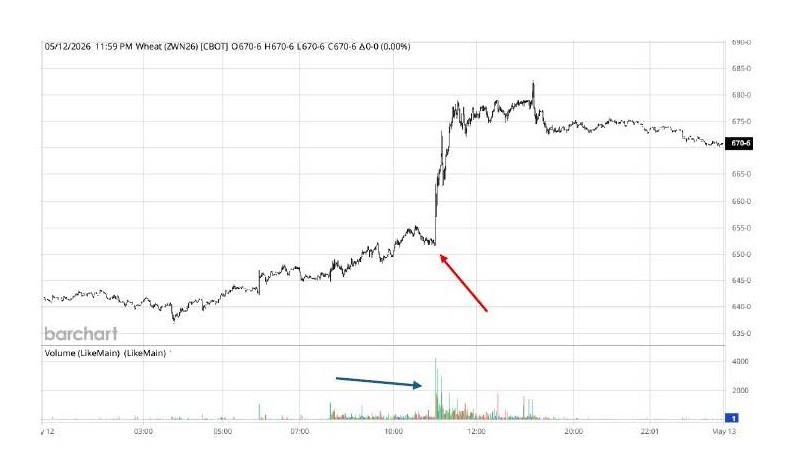
So, what happened to prices right when the WASDE report was released? Wheat futures prices jumped by more than 30 cents in the July contract, triggering a limit move (i.e., the highest a price can move in a single trading session) on Tuesday, settling at $6.79/bu. Most of this price action occurred in less than 15 minutes after the WASDE was released, as shown in the top panel of Figure 1. The report release moment is indicated by the red arrow. This provides strong evidence that market participants incorporated the information contained in the WASDE into prices immediately after its release, suggesting that the report plays an important role in the price discovery process.
Figure 1
Source: Barchart.com
Is there a big participation from market agents, or only a handful of traders engage with the WASDE report?
We have established that WASDE reports appear to move markets by providing supply and demand information that helps agents discover prices. Now, we need to understand the number of traders that effectively engage with this information. If very few people are trading in a market (i.e., liquidity is low), large price swings may occur even when there is no new relevant information. This could bring into question whether the price move observed in wheat futures is information-based or simply the result of a small number of traders creating short-term price distortions.
There is a vast academic literature (e.g., Adjemian, 2012) that shows that WASDE reports are crucial to markets because of their informational quality and public nature, supporting the price discovery process (i.e., market reactions are not mere artifacts of low liquidity or malicious trading). The bottom panel of Figure 1, marked by the blue arrow, shows that the number of trades that occurred immediately after the WASDE was released was significantly higher than during the rest of the day.
This suggests that the observed price movement reflected the participation of many market participants simultaneously incorporating new information, rather than a small number of traders temporarily moving prices. It also indicates that market participants not only consider the information relevant and trustworthy, but that they also trade based on it, leading to fast price discovery. Another way of looking at Figures 1 is that, given the quality of the information and the level of market engagement surrounding WASDE releases, a substantial portion of the market’s price discovery process appears to occur within roughly 15 minutes of the report’s release.
Conclusion
How important are USDA reports? Massively. Given that the most accurate way of determining what prices of a commodity should be is to estimate its supply and demand, reports such as the WASDE provide market agents with key public estimates on the topic.
Traders use the information in these reports to place positions in the market, whether hedging or speculating, leading to an efficient price discovery process. The combination of valuable and reliable information with large amounts of trading activity allows information transmission and price discovery to occur very quickly.
Sources and additional resources:
Michael K. Adjemian, Quantifying the WASDE Announcement Effect, American Journal of Agricultural Economics, Volume 94, Issue 1, January 2012, Pages 238–256, https://doi.org/10.1093/ajae/aar131
https://www.barchart.com/futures/quotes/ZWN26/interactive-chart
Felipe Avileis
Assistant Professor
Department of Agricultural Economics
University of Nebraska-Lincoln
favileis2@unl.edu