
Content
January 21, 2026
Authors:
Jay Parsons, Center for Agricultural Profitability
Tyler Cozzens, Livestock Marketing Information Center
Lamb Feeding Margins: Trends, Challenges, and Profitability Analysis (2020–2024)
Nebraska regularly ranks with Texas as one of the top two states in the U.S. for cattle on feed. Yet, few realize that more than a century ago, Nebraska was also a leading lamb-feeding state. In the late 1800s, over half a million sheep were on feed in Nebraska. In the 1880s, significant feeding occurred near Fremont and Columbus, but by 1890, it was concentrated in sheep feedlots operating along the Platte River valley between Grand Island and Kearney (Wentworth, 1948). Most sheep were trailed in from New Mexico, Colorado, Wyoming, Idaho, and Oregon. Nebraska feedlots offered access to abundant feed and convenient rail shipping to both coasts for consumption.
Recently, there have been some inquiries about the economics of lamb feeding. Does it provide a viable return? The key metric is the “net feeding margin,” calculated as the value of gain (VOG) minus feed costs. In livestock production economics, this figure represents the difference between the value added through weight gain and the cost of feed during the feeding period. It is commonly calculated on a per-head basis, allowing for practical decision-making based on enterprise budgeting and profitability. However, calculating it on a per-pound-of-gain basis offers a clearer economic signal for comparing feeding strategies and cost of gain efficiencies.
The feeding margin is critical because it indicates whether feeding the animal was profitable after accounting for feed expenses. Most producers also include other costs (like yardage, health, and interest) to calculate a more comprehensive feeding return based on the total cost of gain.
Here’s a quick breakdown of net feeding margin:
The formula for calculating the VOG on a per-pound-of-gain basis is:

This calculation provides the value added to the animal per pound of gain while they are on feed. This makes a fair comparison to the cost of gain calculated on a per-pound basis. For example, suppose lambs are purchased at 70 pounds for $2.20 per pound (or $154 per head). They are fed to double their size at 140 pounds and are sold at $2.10 per pound for a value of $294 per head. The VOG is $140 per head (140 = 294 – 154) or $2.00 per pound of gain (2.00 = (294 – 154)/ (140-70)). If feed costs amount to $100 per head, or $1.43 per pound of gain (1.43 = 100/70), then the net feeding margin is $40 per head (40 = 140 – 100) or $0.57 per pound of gain (0.57 = 2.00 – 1.43). This is the amount available in the feedlot to cover other costs (yardage, etc.) and provide a profit. Suppose those other costs are calculated to be $35 per head, or $0.50 per pound of gain. Then, the total cost of gain is $1.93 per pound, and the profit margin is $0.07 per pound of gain or $5 per head.
Lamb Feeding Margins 2020-24
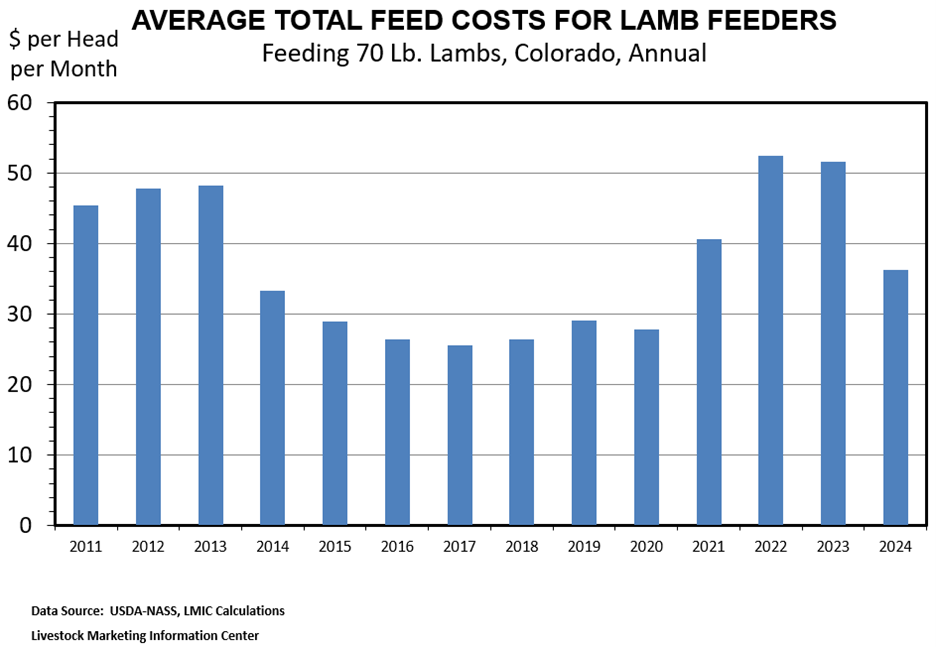
The Livestock Marketing Information Center (LMIC) estimates lamb feed costs per month for a hypothetical lamb feeding operation in Colorado (Figure 1). Most of the lambs on feed in the U.S. are in Colorado. Assumptions underlying the LMIC estimated cost are that lambs are bought and placed on feed at 70 pounds, fed for 90 days, and then sold at a market weight of 140 pounds. This equates to an average daily gain of 0.78 pounds, which is adapted from Knuth, Ryan M., et al. (2020). The total feed ration is 4.50 pounds of feed fed per day, consisting of corn (3.55 pounds per day), alfalfa hay (0.90 pounds per day), and supplements (0.05 pounds per day). Corn and alfalfa hay prices are based on USDA-NASS’s reported prices for Colorado. The feeding costs range from a high of $52.42 per head per month in 2022 to a low of $25.60 in 2017.
Figure 1:
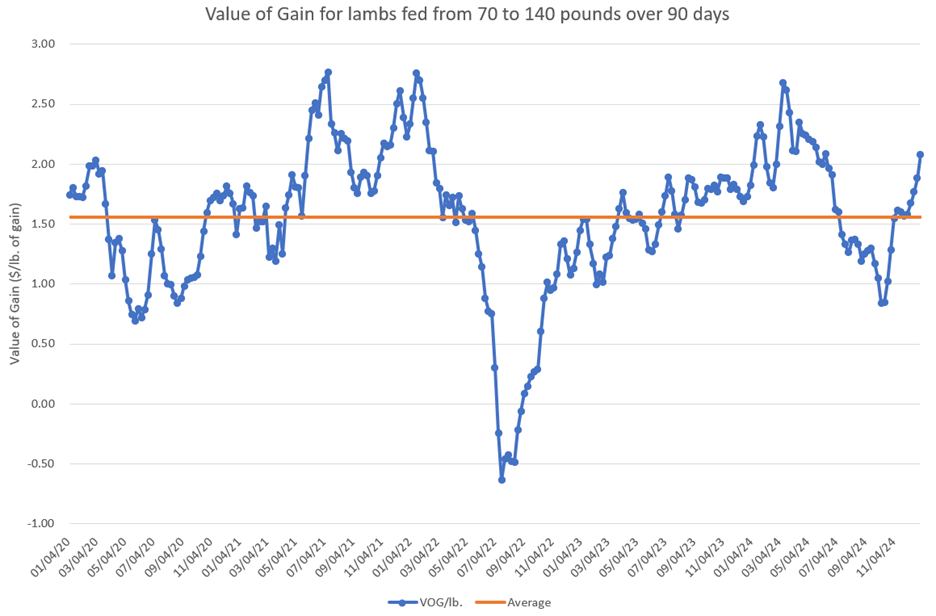
The LMIC also maintains a three-market (CO, SD, TX) average lamb market price series for both 60 to 90-pound lambs and 100 to 150-pound lambs. Using these two-price series, Figure 2 shows the VOG per pound of gain for lambs fed from 70 to 140 pounds over 90 days from 2020 through 2024. The average VOG over that period was $1.55 per pound. Calculated on a weekly basis, the VOG exceeded the $1.55 per pound average 57 percent of the time, indicating values below the average are less likely to occur but occur over a larger range of values. In fact, the VOG was negative for over eight weeks during the summer of 2022, making it impossible for any lamb feeders to make money.
Figure 2: Value of Gain per pound of gain for Lambs Harvested at 140 pounds, fed from 70 pounds to harvest weight over 90 days from 2020-24. Prices obtained from Livestock Market Information Center 3-market average price for CO, SD, and TX for 60 to 90-pound lambs and 100 to 150-pound lambs.
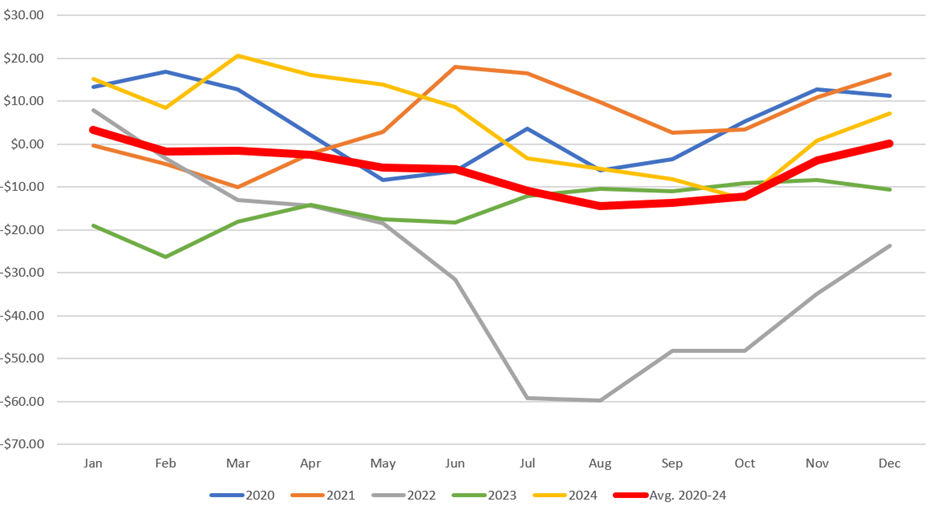
From the perspective of a practical discussion of profitability, lamb feeding margins are best calculated on a per head basis. We convert the annual estimates for 2020-2024 for monthly cost per head in Figure 1 into a 90-day cost per head for each year. We also convert the weekly VOG per pound of gain in Figure 2 into a monthly average VOG per head based on the feeding end date and 70 pounds of gain per head. The net feeding margin per head can then be calculated for each month by subtracting the 90-day feed cost per head from the VOG per head, resulting in Figure 3. The net feeding margins for lamb feeding over the five-year period from 2020 – 2024 were negative 58 percent of the time (35 out of 60 months).
Moreover, the five-year monthly averages (shown in red in Figure 3) are only positive in January and December. Those averages are lowest in August (-$14.45 per head) and highest in January (+$3.40 per head). The late summer low of the average feeding margins is largely due to the volatile year of 2022, when feeding margins reached a low close to negative $60 per head in July and August. That was followed by losses of almost $50 per head for lambs finishing in September and October.
However, about 80 percent of the U.S. lamb crop is born in the first five months of the calendar year (Redden, et al., 2018). These lambs would reach traditional market weight from November through April. This would avoid the late summer losses exhibited in 2022 and, on average, match better with the months of higher net feeding margins. Interestingly, despite all of the negative monthly averages, only 2022 and 2023 averaged a negative net feeding margin across all twelve months (-$28.87 and -$14.58, respectively). The other three years all averaged about $5 per head positive net feeding margin across all twelve months.
Figure 3: Monthly net feeding margin in dollars per head for lambs harvested at 140 pounds, fed from 70 pounds to harvest weight over 90 days. Feeding costs and market prices obtained from Livestock Market Information Center.
Positive feeding margins in the lamb feeding industry have been difficult to achieve since 2020. This is one of many factors putting pressure on the industry. However, 2024 showed marked improvement over 2022 and 2023 when feeding margins were highly negative for all but January 2022. A continuance of lower feed costs and lamb market prices above $2.00 per pound is needed for positive margins to persist.
References:
Knuth, Ryan M., H. C. Cunningham-Hollinger, B. Bangoura, A. L. Julian, C. M. Page, G. L. Hummel, K. L. Woodruff, J. R. Whaley, K. D. Bardsley, S. L. Lake, C. L. Gifford, B. Bisha, and W. C. Stewart. 2020. “Impacts of Dietary Zinc Concentrations on Lamb Feedlot Performance.” Translational Animal Science 4 (Suppl 1): S6–S10. https://doi.org/10.1093/tas/txaa087.
Redden, Reid, Erica Sanko, Richard Ehrhardt, and Cody Hiemke. 2018. “Seasonality of the US Lamb Industry: A Review of Current Information.” Industry White Paper. American Lamb Board. Available from https://lambboard.com/productivity. Downloaded Dec. 14, 2025.
Wentworth, Edward Norris. 1948. America’s Sheep Trails. Ames, IA: The Iowa State College Press.
Jay Parsons, Professor
Director, Center for Agricultural Profitability
Department of Agricultural Economics
University of Nebraska-Lincoln
jparsons4@unl.edu
Tyler Cozzens
Livestock Marketing Information Center
https://lmic.info/