
Content
September 16, 2026
The Role of Education on Livestock Risk Protection Utilization
In United States, cattle producers can manage risks in their operations utilizing several federally supported tools. They can also receive education on utilization of these tools. Livestock Risk Protection (LRP) is one such tool that provides feeder cattle producers with insurance against falling national prices. While LRP is tied to the underlying futures market, it offers flexibility to enroll animals on a per-head basis, which is valuable especially for smaller operations.
LRP is offered through the Federal Crop Insurance Program (FCIP), jointly administered by the United States Department of Agriculture-Risk Management Agency (USDA-RMA) and the Federal Crop Insurance Corporation (FCIC). FCIP subsidizes producers’ premium payment to encourage insurance participation. Also, USDA spends significant resources on producer education on LRP to increase awareness and potential adoption. Participation in LRP was negligible until 2018, with utilization mostly concentrated in a handful of Midwestern states. For instance, in 2023, South Dakota purchased 225 LRP policies per one thousand beef-cow operations, while in some other states outside the Midwest, LRP has not been utilized.
To boost participation, USDA-RMA has made several adjustments to LRP since its introduction in 2003 as a pilot program in ten states: Colorado, Iowa, Kansas, Nebraska, Nevada, Oklahoma, South Dakota, Texas, Utah, and Wyoming. USDA-RMA increased the premium subsidy rate from 13% up to 55% (contingent upon coverage levels) following the Bipartisan Budget Act of 2018 and removed the $20 million annual funding cap for livestock insurance. Most LRP policies purchased are above the 95% coverage level, which receives a 35% subsidy. In addition to the tired subsidy rates with the coverage levels, beginning farmers/ranchers, and military veterans get an additional 10% subsidy. LRP expanded beyond the pilot states over time and became available in all fifty states by 2019.
Besides changes in the subsidy rate and program adjustments, producer education on feeder cattle LRP has been continuous. Producers receive education from various sources, including the Extension Risk Management Education (ERME) program. ERME provides the best documented evidence of the educational effort on LRP. The United States Department of Agriculture-National Institute of Food and Agriculture (USDA-NIFA) competitively funds regional ERME centers (4 regional centers and one digital center) to, in turn, administer regional competitive grant programs that fund producer-focused education projects, including those addressing LRP. Over the 2003–2023 period, the number of completed days of workshops supported by ERME funding that focused on LRP for feeder cattle averaged 0.63 per year per state and varied from 0 to 50 workshops. However, no previous studies have documented the impact of these educational initiatives on LRP utilization within US feeder cattle market.
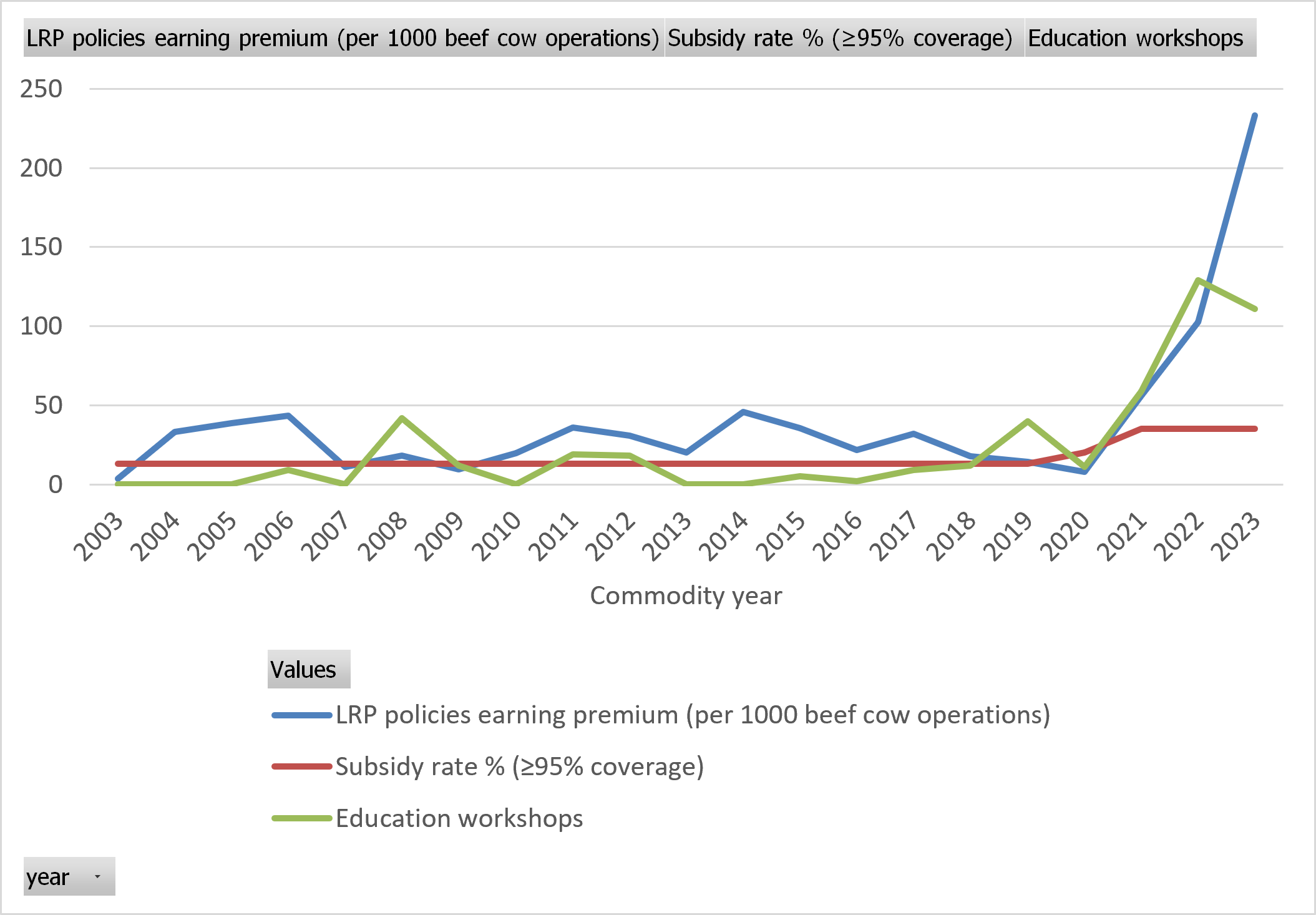
The graph provides an aggregate summary of changes in policy sales, subsidy rates and educational workshops across the country since 2003. The substantial growth in policy sales in recent years occurred as both educational efforts and subsidy rates also grew substantially. Our study is the first to provide evidence of effects of these long-term educational initiatives on promoting LRP utilization. Using a stateyear panel data set from 2003–2023 and a two-part econometric model, we distinguished the effects of factors that affect insurance participation decision with those governing the level of insurance participation in LRP utilization. In brief, we find that the role of education is valuable to build the knowledge base, and the effect depends on producers’ familiarity with the product, evolution of the product, and financial incentives received by producers.
Specifically, education drives LRP utilization in making insurance participation decisions. More education workshops increased producers’ likelihood of adopting LRP but did not affect the level of insurance participation. Education showed a dominant role on adoption decisions in states where producers are less familiar with the product (non-pilot states) and during early ramp up stages in familiar states (pilot states). Education in fact is still a growing driver in non-pilot states, but its marginal effect is diminished in pilot states. Beyond education, higher subsidy rates which provide financial incentives are the dominant factor in familiar states (pilot states) at adoption stage and drive the overall level of insurance participation in both pilot and non-pilot states.
Our work also documented the impact of farm structure and economic factors on LRP utilization. We found that the probability of LRP participation increased as the herd size increased to an optimal number but dropped back down as the herd size increased beyond optimum. This suggests that producers with smaller to mid-sized operations were more likely to participate in LRP. The estimated herd size that led to the maximum probability of LRP participation was 94 beef cows. Producers were less likely to participate in LRP as feeder cattle prices increase but increased price volatility increased participation. Although these two effects could co-exist, the price volatility effect was greater than the price effect.
The study provided evidence of the impact of education on producer risk management practices. The ERME program is designed to support projects that educate producers and help them manage risk. This study helps document that education plays an important role in risk management even as programs and economic conditions continue to change.
Acknowledgements: This work was supported by USDA/NIFA under Award Number 2021-70027-34694.
Milan Chauhan
PhD studentAgricultural Economics
University of Nebraska-Lincoln
mchauhan2@huskers.unl.edu
Brad Lubben
Extension Associate Professor, Policy Specialist, and
Director, North Central Extension Risk Management Education Center
Agricultural Economics
University of Nebraska-Lincoln
brad.lubben@unl.edu